Hello my fellow time travellers and curious cats!
This cabinet of curiosities is an accumulation of artefacts I found while exploring the depths of our cultural history. The past and its remainders have always had an almost mystical spell on me and the weird things our human history has brought to light always leaves me in awe.
But don’t be afraid! I’m not in danger of losing myself in the past. Sometimes, curious things happen in the present, too…
This blog is a more ambitious successor of this one: http://misspygmalion.blogspot.de/
…
- Follow me, if you want to dive right into it!
- You can learn more about me here.
- Scroll down if you’re curious about the page’s name.
…
Why ‘Miss Pygmalion’?
I have always loved greek mythology. It is loaded with imagery that has existed for thousands of years in human history. And it is incredible how it still manages to influence a lot of cultures in the present.
As you may know, the Pygmalion myth was most popularly depicted by Ovid in his Methamorphoses. Pygmalion is a sculptor and a mysogynist. In his hatred for women he decides to give up love and just live for his art. One day, he absentmindedly creates an incredibly realistic sculpture of a woman and falls in love. He is so hopelessly in love, that Venus, the goddess of love, turns her into a real woman. Later, in the 18th century, the name of this woman becomes Galatea. This myth has been an inspiration for many a work of art, mostly sculptures and paintings of course, but also for a play by G. B. Shaw. This play was the basis for the incredibly popular musical ‘My fair Lady’.
As a feminist, it is always hard to look past the mysogyny in both the myth and especially the play. But as an art historian, one has to have the open mindedness to look past these things to see its artistic value (By looking past I don’t mean forgetting it! One should always be aware of it).
So, I named this project after the myth, not the play. And there is one aspect of the myth that can be representative of something that is very dear to me as an art historian: Art can change your mindset. Just by exposing yourself to it, it can open your way of thinking. It can make you more tolerant and open-minded towards anything (like Pygmalion towards women). And that is why art fascinates me.
If you’d like to ask me something, or discuss this topic, just send me a message.
…
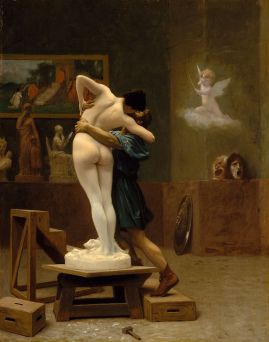
Jean-Léon Gérôme, Pygmalion and Galatea, 1890
…
 miss pygmalion